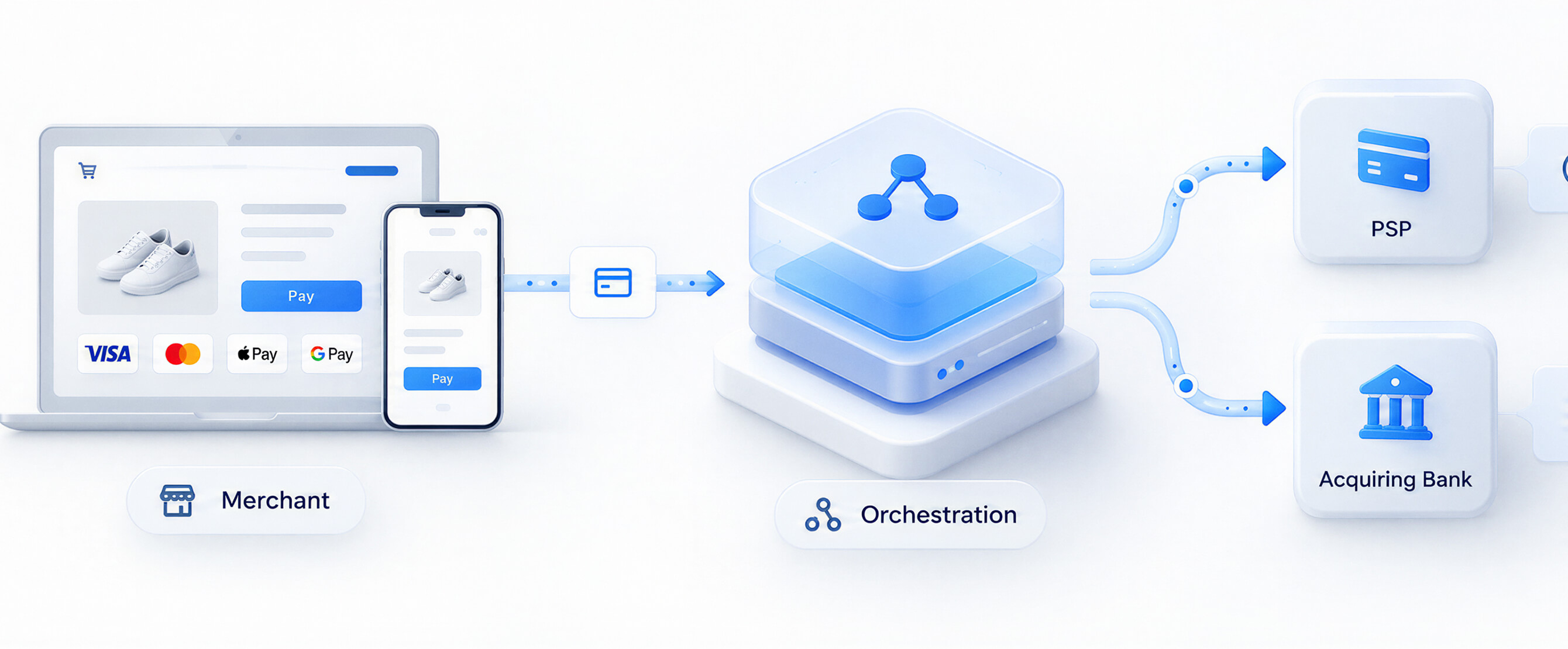
Payment terminology gets thrown around loosely, and "acquirer," "PSP," and "orchestration platform" often get used interchangeably even though they refer to distinct roles with distinct responsibilities. Understanding the difference matters – especially when it comes to knowing who is actually responsible for what in a transaction.
The Acquiring Bank
An acquiring bank (or "acquirer") is a licensed financial institution that has a direct relationship with card networks and is authorized to process card payments on behalf of a merchant. The acquirer is the entity that ultimately settles funds into the merchant's account, and it carries significant regulatory and compliance responsibility, including adherence to card scheme rules and financial regulations.
The Payment Service Provider (PSP)
An acquiring bank (or "acquirer") is a licensed financial institution that has a direct relationship with card networks and is authorized to process card payments on behalf of a merchant. The acquirer is the entity that uA PSP typically provides the technology and services that let a merchant accept payments, often working in partnership with one or more acquiring banks behind the scenes. Depending on the PSP's model, it may handle some of the technical processing while the underlying acquiring relationship – and the associated settlement and compliance responsibilities – sits with a partner bank.
The line between "acquirer" and "PSP" can blur depending on a provider's specific licensing and setup, which is part of why the terminology gets confusing. What matters most for a merchant is understanding, for any given partner, exactly which responsibilities they hold.
ltimately settles funds into the merchant's account, and it carries significant regulatory and compliance responsibility, including adherence to card scheme rules and financial regulations.
The Orchestration Platform
An orchestration platform is a different kind of participant altogether. Rather than processing, acquiring, or settling funds, it provides the technical layer that connects a merchant to the acquiring banks and PSPs they've chosen to work with. It routes payment requests, but it does not sit inside the chain of financial responsibility for those transactions.
This is a meaningful distinction. A well-scoped orchestration platform:
- Does not hold or settle customer funds
- Does not perform merchant acquiring activities
- Does not take on the regulatory obligations that belong to acquiring banks and PSPs
Those responsibilities remain with the merchant's chosen acquiring and payment partners – the orchestration layer simply makes it easier to connect to them.
Why the Distinction Matters
Knowing which entity is responsible for what isn't just a technicality – it affects how a merchant thinks about risk, compliance, and vendor relationships. If something goes wrong with settlement or a regulatory question arises, knowing whether that responsibility sits with an acquirer, a PSP, or a technology layer determines who a merchant needs to work with to resolve it.
A merchant working with a payment orchestration platform should be able to clearly answer: who holds our funds, who settles our transactions, and who is accountable for regulatory compliance? If a platform's role is purely technical, those answers should point to the acquiring banks and PSPs – not to the orchestration layer itself.
The Takeaway
Payment stacks often involve more than one type of participant, each with a different role. Understanding those roles – acquirer, PSP, and orchestration platform – makes it easier to evaluate partners clearly, ask the right questions, and know exactly where responsibility sits at every stage of a transaction.