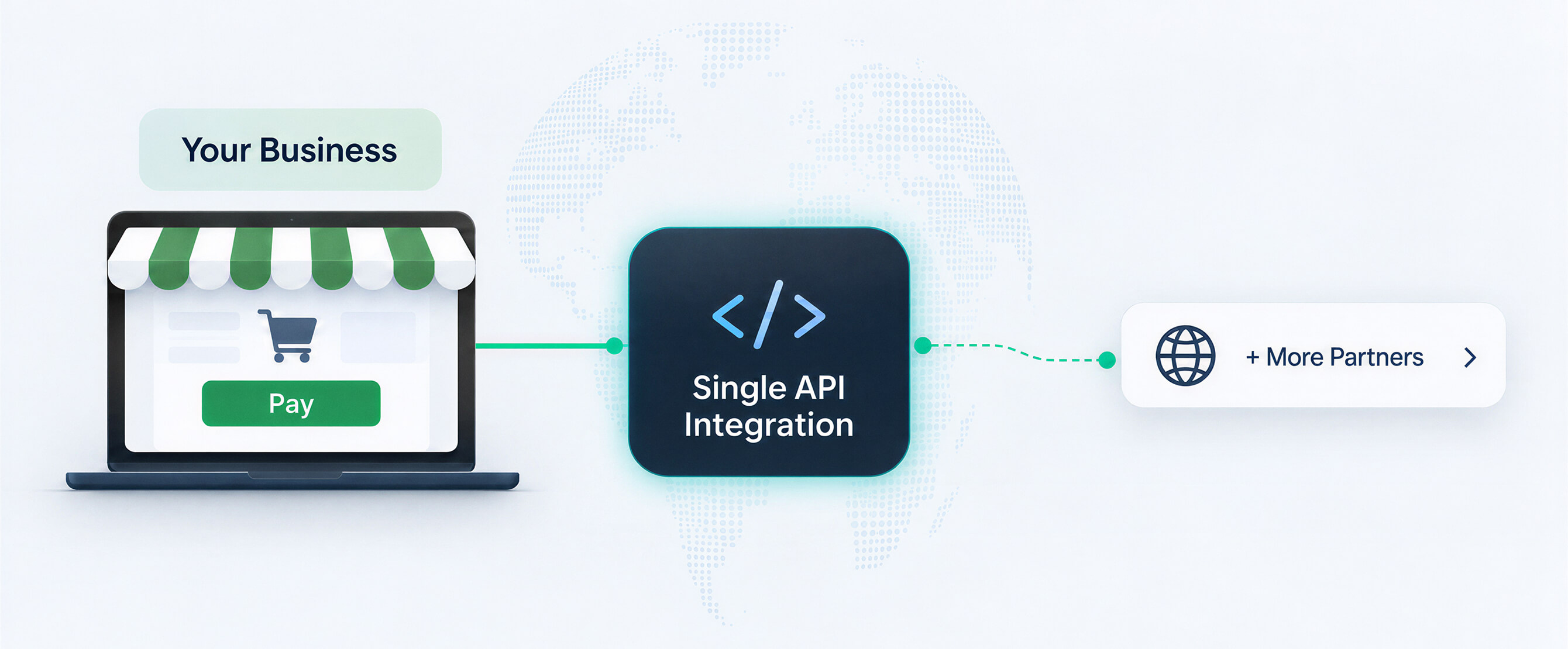
"Integrate once, connect to many providers" is easy to say and harder to picture in practice. This article looks at what actually happens technically when a merchant integrates with a single API that sits in front of multiple acquiring banks and payment service providers.
The Traditional Approach
Without an orchestration layer, connecting to a new payment provider typically means:
- Reviewing that provider's specific API documentation
- Building and testing a dedicated integration for their request and response formats
- Handling that provider's specific error codes, retry logic, and edge cases
- Repeating steps 1–3 for every additional provider
Each of these integrations is usually maintained separately, which means updates, deprecations, or changes on the provider's side can each trigger their own round of engineering work.
How Single-API Connectivity Changes This
A single-API orchestration model inverts this structure. The merchant builds one integration – to the orchestration platform itself – using one consistent set of endpoints, data formats, and conventions. The orchestration platform then maintains the individual connections to each acquiring bank or PSP behind that single API.
From the merchant's side, this typically looks like:
- One authentication and integration process, regardless of the number of connected partners
- One standardized way to send a payment request, independent of which partner ultimately processes it
- One place to view transaction status and history across all connected partners
Adding a New Partner Without Starting Over
Perhaps the most practical benefit shows up when it's time to add a new acquiring bank or PSP. In a traditional setup, that means a new integration project. In a single-API orchestration setup, it typically means enabling a new connection within the platform – a configuration change rather than a development cycle.
This matters most for businesses that expect their partner mix to change over time: expanding into new markets, adding redundancy for reliability, or renegotiating terms with providers. Each of those scenarios becomes significantly less disruptive when it doesn't require new engineering work every time.
What Stays the Same
Single-API connectivity changes how a merchant integrates – it doesn't change who is responsible for what once a transaction reaches a given provider. Processing, settlement, and regulatory compliance remain with the acquiring bank or PSP handling that transaction. The orchestration layer's role is limited to the technical routing of the request.
The Bottom Line
Single-API connectivity is, at its core, about reducing repeated technical work. Instead of N integrations for N providers, there's one integration and a configuration layer for managing the rest – which keeps engineering effort proportional to what a business is trying to do, not to how many payment partners it happens to work with.