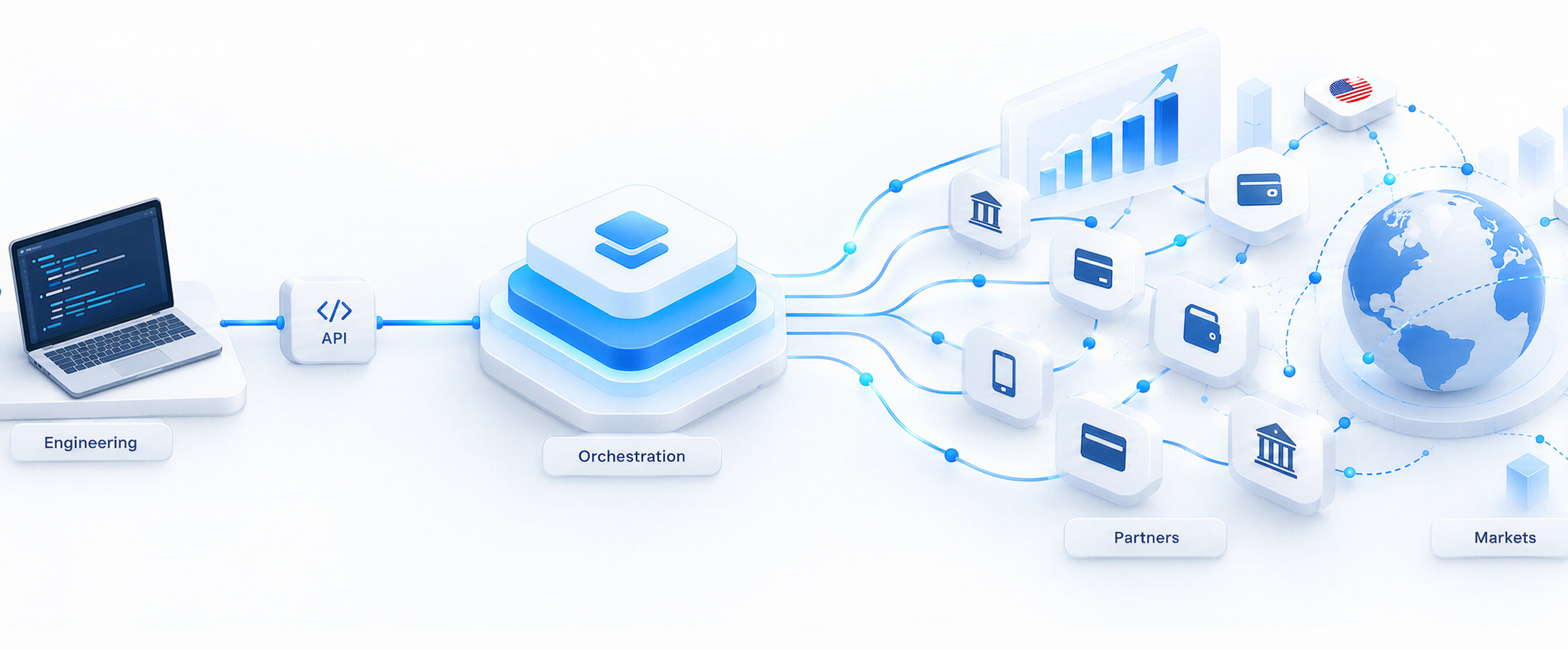
Growth usually means more of everything – more markets, more transaction volume, more payment methods, sometimes more payment partners. The question worth asking is whether your engineering effort has to grow at the same rate. In a well-designed payment stack, it shouldn't.
Where Engineering Effort Usually Comes From
In a typical payment setup without a centralized orchestration layer, engineering work tends to scale with the number of payment relationships a business manages. Each new acquiring bank or PSP usually means a new integration project: new documentation to work through, new testing and certification, and a new set of edge cases to handle.
Multiply that by every new market entered or every new provider added for redundancy or better terms, and it's easy to see how a payments team can end up spending most of its time on integration maintenance rather than on the product itself.
Decoupling Growth From Integration Work
A centralized SaaS orchestration layer changes this relationship. Once a merchant has integrated with the orchestration platform, adding a new acquiring bank or PSP becomes a matter of enabling and configuring that connection within the platform – not building a new integration from scratch.
This has a direct effect on how engineering effort scales:
- Adding a payment partner becomes a configuration task rather than a development project
- Expanding into a new market doesn't require a parallel integration effort for that market's preferred providers
- Increasing transaction volume doesn't require re-architecting the payment stack, since the platform is built to handle that scale
What "Predictable" Actually Looks Like
Predictable engineering effort doesn't mean zero effort – there's still work involved in configuring new partners, testing routing rules, and validating that new connections behave as expected. What changes is the type and size of that work. It shifts from "build and maintain a new integration" to "configure and validate a new connection within a system you already operate."
For a growing business, that shift matters. It means payments and engineering teams can plan for growth without needing to staff up proportionally every time the payment stack needs to expand.
The Practical Upshot
Scaling payment operations shouldn't feel like starting over each time. A centralized orchestration layer is, in large part, a way of making sure that growth in your business – new markets, new partners, more volume – doesn't automatically translate into a growing backlog of integration work.