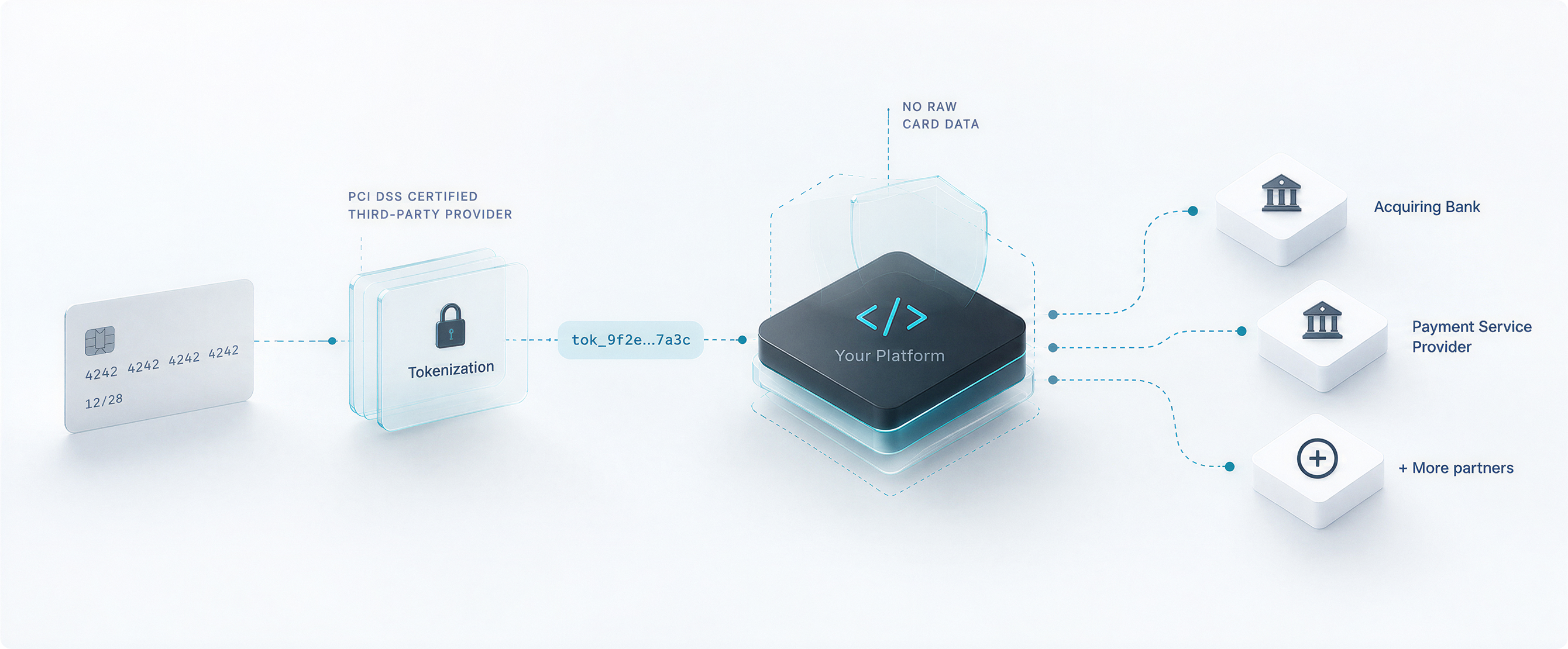
"Security by design" is one of those phrases that shows up on nearly every technology vendor's website. It's worth unpacking what it actually means in practice – particularly for a platform that sits in the payment chain, where the stakes of getting security wrong are especially high.
Security as an Architecture Decision, Not a Feature
The common alternative to security by design is treating security as something added after a system is built – a set of controls layered on top of an existing architecture to address gaps as they're discovered. This approach tends to produce systems where security depends on remembering to apply the right controls consistently, everywhere, every time.
Security by design takes a different starting point: security considerations shape the architecture itself, before a single feature is built. That means asking, at the design stage, questions like:
- Does this system need to hold this data at all, or can that responsibility sit elsewhere?
- What is the smallest set of information this component needs to do its job?
- If this system were compromised, what would actually be exposed?
What This Looks Like in a Payment Orchestration Platform
For a platform that routes payment requests between merchants and their payment partners, security by design shows up in concrete architectural choices:
- Minimizing sensitive data on the platform. Using a PCI DSS certified tokenization provider to handle raw card data means the orchestration platform itself never needs to store or process it – removing an entire category of risk rather than managing it after the fact.
- Clear scope of responsibility. Structuring the platform so that it facilitates the technical transmission of payment requests, without holding funds or taking on acquiring activities, keeps the boundaries of what could go wrong clearly defined.
- Predictable, documented data flows. When every connection, route, and integration point is documented and consistent, it's easier to audit the system and to reason about where risk could arise.
Why This Matters More in Payments Than Elsewhere
Payment systems are a particularly high-stakes environment for security, because the potential impact of a failure – a data breach, a compliance violation, a loss of merchant trust – is significant and often irreversible in terms of reputation. Retrofitting security into a payment system after the fact is possible, but it's harder, slower, and less reliable than building it in from the beginning.
The Underlying Principle
Security by design, stripped of the marketing language, comes down to a simple discipline: make deliberate choices about what a system needs to know, hold, or do – and build the architecture so that anything it doesn't need, it simply doesn't have access to. For a payment orchestration platform, that discipline shows up most clearly in decisions like keeping raw card data out of the platform entirely, and keeping the platform's role limited to the technical layer it's actually meant to serve.