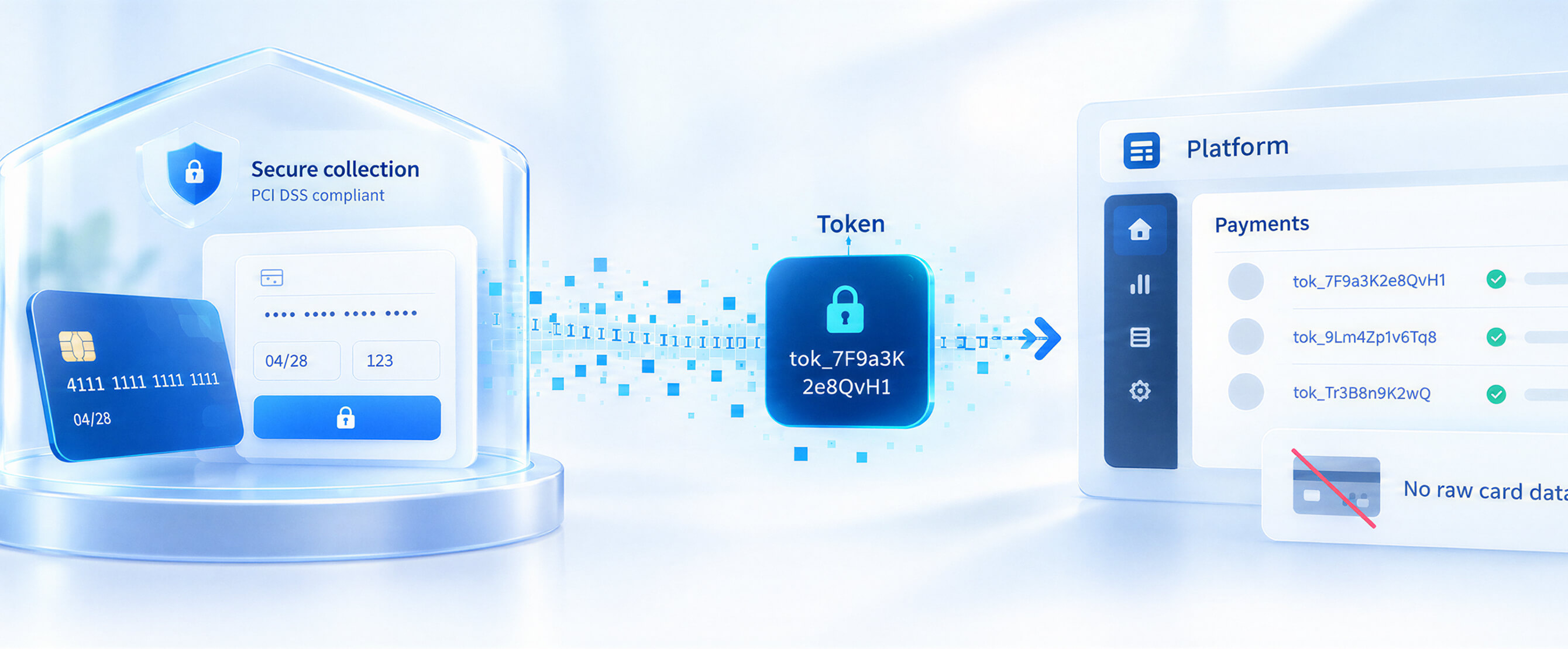
Card data is one of the most sensitive categories of information a payment platform can touch – and one of the clearest ways to reduce risk is simply not touching it. This article explains how tokenization makes that possible, and what it means for a platform to process only tokens instead of raw card data.
The Risk of Handling Raw Card Data
Any system that stores or processes raw payment card data – the card number, expiry date, and related fields – takes on significant security responsibility. That includes strict compliance obligations under the Payment Card Industry Data Security Standard (PCI DSS), as well as the operational risk of being a potential target for data breaches.
The more systems that touch raw card data, the larger the attack surface. This is one of the reasons tokenization has become a standard practice in modern payment architecture.
What Tokenization Does
Tokenization replaces sensitive card data with a non-sensitive substitute – a "token" – that has no exploitable value on its own. The token can be used to reference a transaction or a stored payment method, but it cannot be reverse-engineered into the original card number without access to the secure system that created it.
In a typical tokenized flow:
- Card data is collected directly by a PCI DSS certified tokenization provider, not by the platform orchestrating the transaction
- That provider generates a token representing the card data
- The token – not the card number – is passed along to the platform, along with the transaction details needed to process the payment
- The original card data stays within the tokenization provider's secure environment
Why This Matters for a Platform Like Okards
Okards uses a PCI DSS certified third-party tokenization provider to securely collect and tokenize payment card data before it ever reaches our platform. As a result, Okards processes only non-sensitive payment tokens together with the transaction information required to orchestrate payment requests – never raw card data.
This has a few concrete implications:
- Reduced data exposure – Sensitive card data isn't present on the orchestration platform, which limits what could be exposed if any single system were compromised.
- Clear compliance boundaries – Card data handling is concentrated with the certified tokenization provider, rather than spread across every system in the payment chain.
- No change to functionality – Tokens carry enough information to route and process transactions, so orchestration and routing work the same way they would with raw card data.
The Bigger Picture
Tokenization is one of the clearer examples of a security principle worth applying broadly: the safest way to protect sensitive data is often to avoid holding it in the first place. For a payment orchestration platform, that means being deliberate about which systems in the chain actually need to see card data – and building the architecture so that the answer, for as many systems as possible, is "none."