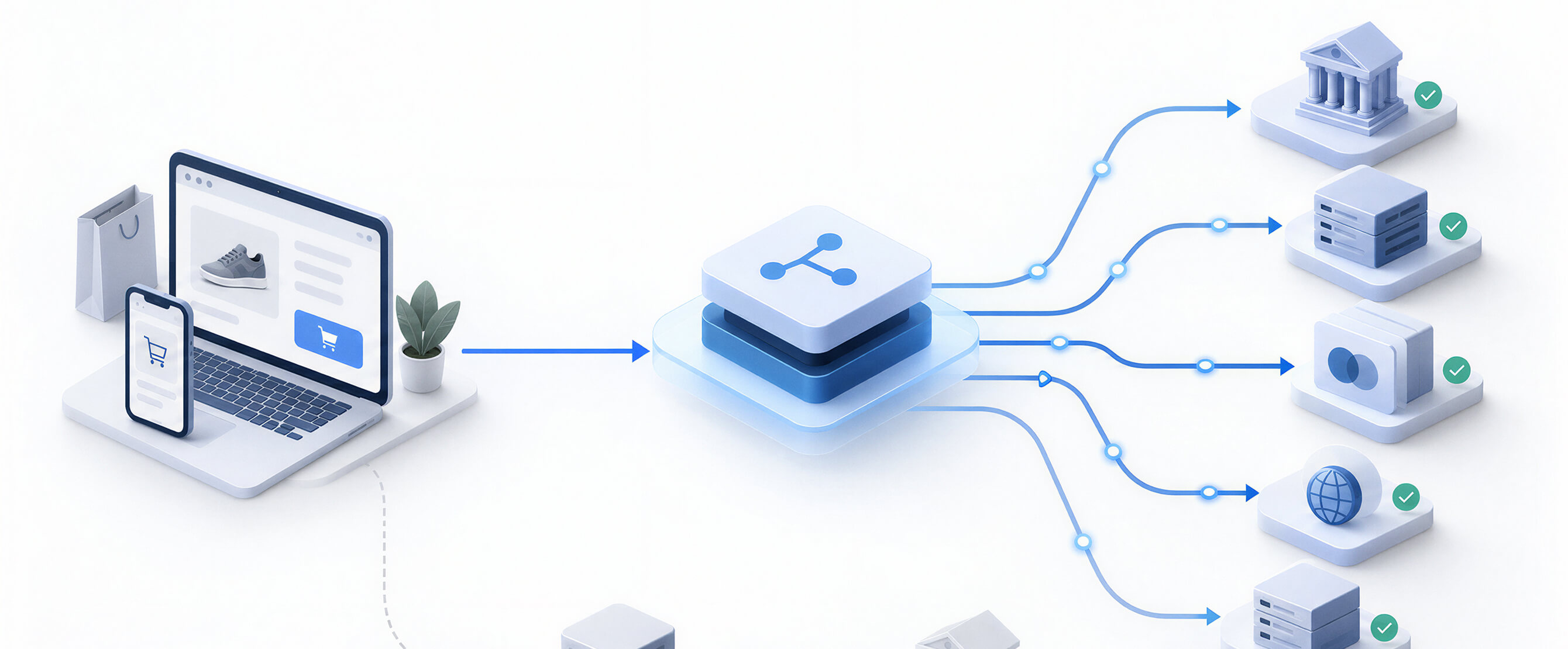
If you've spent any time researching how to connect your business to more than one payment provider, you've probably run into the term "payment orchestration." It gets used a lot, and not always consistently. So before talking about why it matters, it's worth being precise about what it actually is.
The Problem Orchestration Solves
Most businesses don't start out needing more than one payment partner. A single acquiring bank or payment service provider (PSP) is usually enough to accept payments and get started. But as a business grows – new markets, new payment methods, a need for redundancy, or simply better commercial terms from a second provider – the number of payment relationships tends to grow with it.
The trouble is, each of those relationships usually comes with its own integration. Different APIs, different data formats, different testing and certification processes, different ongoing maintenance. What started as "accept payments" turns into "maintain N separate payment integrations," where N keeps growing.
What Orchestration Actually Does
A payment orchestration platform sits between a merchant's systems and its payment partners as a centralized technical layer. Instead of building and maintaining a direct integration with every acquiring bank or PSP, a merchant integrates once with the orchestration platform. The platform then handles the technical work of connecting to each individual partner behind the scenes.
In practical terms, that means:
- One API to integrate, regardless of how many payment partners sit behind it
- A single place to add, remove, or reconfigure payment partners
- Standardized data and request formats across providers with different technical requirements
What Orchestration Is Not
It's worth being clear about what orchestration doesn't change. A properly scoped orchestration layer does not become your acquirer, does not hold or settle funds, and does not take on the regulatory obligations that come with processing payments. Those responsibilities stay exactly where they've always been – with the licensed acquiring banks and PSPs a merchant chooses to work with.
Orchestration is a technology layer, not a new financial intermediary. That distinction matters, because it keeps accountability clear: your payment partners are responsible for processing and settlement, and the orchestration platform is responsible for making the technical connection to them simpler.
Why It Matters
For any business managing more than one payment relationship, the case for orchestration comes down to engineering time and operational flexibility. Instead of a new integration project every time a payment partner is added or changed, that work becomes a configuration change within a platform you already know.
That's not a marginal efficiency gain – for businesses expanding into new markets or adding payment methods regularly, it's often the difference between shipping in weeks versus months.